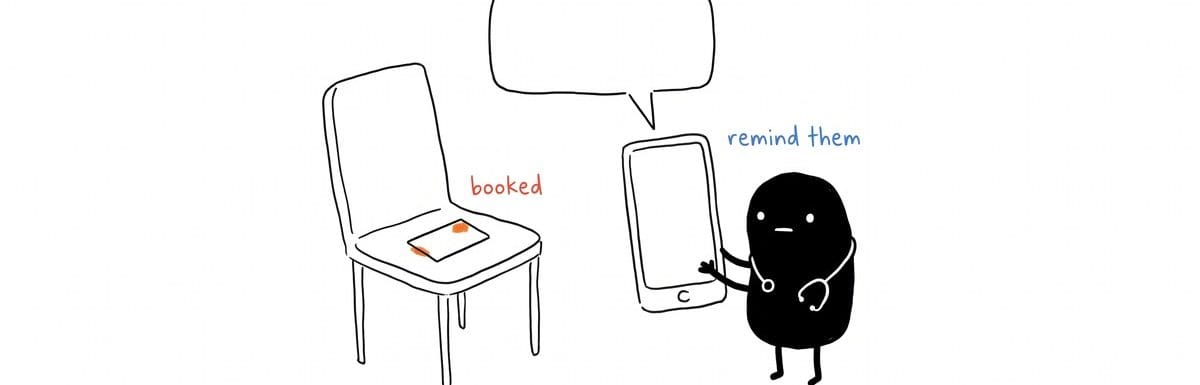
The seasoned doctors we know and have spoken to already know that patients don’t show up all the time. Many new doctors are probably experiencing this right now. A certain percent will never show up. For some doctors, it’s as high as 50% of the patients scheduled ahead of time.
That’s why we keep studying it. Our first study was years ago. We examined specialty practices, and 40 to 50% of their patients were not showing up. With our built-in reminders released during that time, 30 to 40% of the patients who would have missed their appointment showed up. We’ve kept studying it since, because people change their behavior, and patients do too.
The usual suspects
Patients rarely tell the doctor what actually happened, so for the most part, we can only assume.
It’s the usual suspects. Forgetting is at the top. Then there are patients who book, and by the day of the consultation, they don’t feel the issue anymore, so they don’t show up. I think it’s a local culture thing. Once people feel okay, they ask themselves why they should still go to the doctor and pay for it.
Payment is another reason. In other countries, it’s not out of pocket most of the time. Here in the Philippines, a lot of it is out of pocket. And even with an HMO, it takes time to get the LOA, line up, and get a schedule with a doctor who accepts that HMO for their situation.
Confirm with them one by one
The most basic one is getting the secretary to contact these patients one by one and confirm with them that their slot is reserved. Usually, it’s just an SMS from the secretary. A phone call is rare. And sometimes the secretary misses a patient. That’s human error.
Some doctors use automation software. That’s why we built it into SeriousMD. Outside of software, the only other way right now is the secretary calling or texting by hand.
A lot of patients actually appreciate the reminders and follow-ups, because a lot of them really just forget about their appointment. It’s not that they’re doing it on purpose.
It’s a balancing act
A majority of practices in the Philippines are not scheduled, and doctors don’t really get paid if people don’t show up, unlike in other countries. Here, it’s first come, first served. If a doctor limits their slots and people don’t show up, that’s lost income.
So it’s a balancing act. Culturally, doctors don’t like charging ahead of time. But without it, people just don’t show up. The biggest deterrent for no-shows is payment. If the patient has already paid, there’s a high chance they’ll show up. The doctors who limit their slots and don’t collect payment ahead of time are the ones losing potential income.
A lot of them don’t want the hassle of it, so they’re not too worried about it. But from the outside looking in, people like me can see the earning potential being missed. We also have to be sensitive about it, especially in medicine.
For patients who skip because of the cost, I’m not sure there’s much anyone can do. The doctor might lower their fee, but the question is, should he or she do that?
Don’t hold a grudge
Number one, don’t get angry, and don’t blame the patients. A chunk of it is solvable with things like automation and a secretary who calls and texts. Do what you can. Outside of that, there’s really nothing more you can do.
What you shouldn’t do is hold a grudge against that patient. It’s a normal part of running a practice. People don’t show up; it’s a fact of life.
Start with a baseline
It helps to know your starting number of no-shows. That gives you a baseline, especially if you don’t have a follow-up system in place yet. That can be done more efficiently with software like ours, but you can still do it with pen and paper.
Then add one thing at a time, and you’ll see more patients actually show up.
If you want to start with reminders, we have three kinds of reminders you can send patients. We have some more and we’ll keep sharing what we learn about no-shows, so check back here in the future.