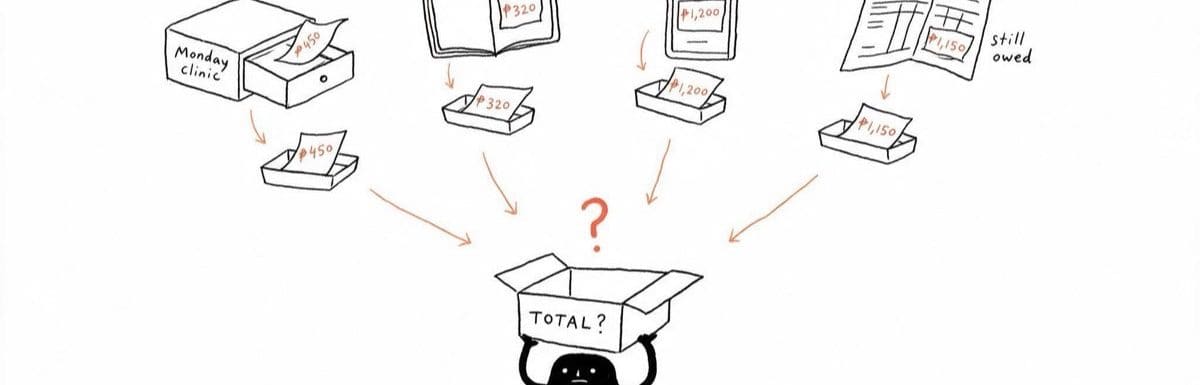
When you want to know exactly what you made last month, where do you look?
I’ve been asking doctors that for years. Not the number, to be clear. That’s nobody’s business but yours, and honestly I’d be a little worried about a doctor who told a software guy their income over merienda. I only want to know where you’d go to look it up.
The answers come fast, and they’re never the same twice. The notebook in the drawer. My secretary keeps it. The receipt booklet. GCash screenshots. The hospital statement, whenever that shows up. Some just laugh and say they’ll get to it.
Almost nobody says one place.
It isn’t a discipline problem
For a long time I thought it was. It isn’t.
A private practice here is really three or four small businesses running at once. The Monday clinic takes cash at the desk. The one across town has its own staff and its own book. The hospital pays on its own cycle. HMO and PhilHealth on two others.
Each of those is a partial record, held by a different person, on a different schedule. Every one of them is doing its job properly. None of them was ever asked to produce the total, so the total doesn’t exist anywhere. It isn’t lost. It was never assembled.
Why doctors actually fix it
Almost nobody fixes this because they decided to get organized.
When our users tell us why they finally started putting everything in one place, it’s usually one of two things.
The first is exhaustion. One more spreadsheet, then the second spreadsheet, then the other software that only covers one clinic. At some point the reconciling costs more than the money it’s protecting.
The second one they tell me more quietly. Someone in the clinic was taking from them. And it’s almost never a big amount. One or two consultations a day, which is small enough that nothing ever looks obviously wrong.
Honestly, it depends on the person. Different clinics, different reasons. But underneath it’s the same thing. When nobody’s holding the total, nobody can tell when part of it goes missing.
The five-minute test
Without asking your secretary, and without opening three different apps, write down what you earned last month.
If you can’t, that’s your answer. It doesn’t mean anything is wrong.
What actually fixes it
I should say plainly that we offer an EMR, so treat anything I say about software with the suspicion it deserves. If you are shopping for one, I wrote a separate piece on how to tell a real EMR from a rebranded template. What follows holds either way, and it’s cheaper than anything I sell.
Pick one place. Then make everything land there.
That’s the whole thing. What matters isn’t which tool, it’s that there’s exactly one of them. One notebook is fine, as long as it’s the only one. What breaks a practice’s books is never the notebook. It’s the notebook plus the ledger plus the app plus the folder of screenshots, each holding a piece, none of them holding the total.
If you want a starting shape, this is the minimum that makes a month reconcilable:
- The date and which clinic. Without this you can’t tell which of your practices is actually carrying you, and most doctors are wrong about which one it is.
- What came in, and how. Cash, card, GCash, HMO, PhilHealth. Same row, different column.
- What’s still owed. The claim submitted but not paid. The patient who said next time. This is the column most people skip, and it’s the one that turns a record into a total.
Then once a month, add it up. Not to be organized. So that when the number moves, you notice that it moved.
None of this is impressive. I’ve written before about why I bet on the boring work, and this is the clinic version of the same bet.
You can see 40 patients in a week and still not know what you earned that week. In most cases nothing went wrong.
But you can’t tell.